
In my last post I touched upon the baby boomer generation's positive impact to the overall economy. Given that they were a good catalyst to 50 years of stock market explosions, I'd say it's worth examining this group a little closer.
Ask a boomer how much they paid for their first home 30 years ago and you will probably hear a price that seems ridiculously cheap by today's standards. Then ask them what their household income was a the time, and you'll probably hear an answer that makes today's home prices look ridiculously expensive.
My own parents paid a price for their home that was about 2 times their annual salary. The banks just didn't throw around their money back then, and interest rates were a 'modest' 6%. They worked hard to pay off the entire mortgage, and at the end of it they had a mortgage-burning party to celebrate the fact that they were out of debt.
Contrast this to today's situation, where a home's price can average up to 3-4 times the income of the entire household, and homeowners think nothing of taking out a line of credit on their home equity. How exactly did we get here? The simple answer is that the more people take out loans to buy homes, the higher home prices rise. This in turn raises the tolerance of the banks to hand out more loans for less home equity. The more loans the banks hand out, the higher the home prices rise, and so on and so on... until about 3 years ago when the housing crisis hit.
Before 2008, this leveraging situation was never really a major problem as the cycle played out at a micro-level. Every 7 years or so, home prices would get (relatively) soft, the economy corrected lower, but then the cycle always continued.
The housing crisis of 2008 marked a major shift in this trend, and people were worried that this time the correction down would be permanent... or at least longer than any previous cycle.
If you talk to a (good) financial advisor, one of the strategies they would advise during this period is to move your money out of inflationary instruments such as commodities, and into government bonds - the theory being that as money lending decreases (de-leveraging), central banks will raise interest rates. As you can see from this 3-year chart of the 30-year US Treasury, people have been following this strategy in spades since 2008. 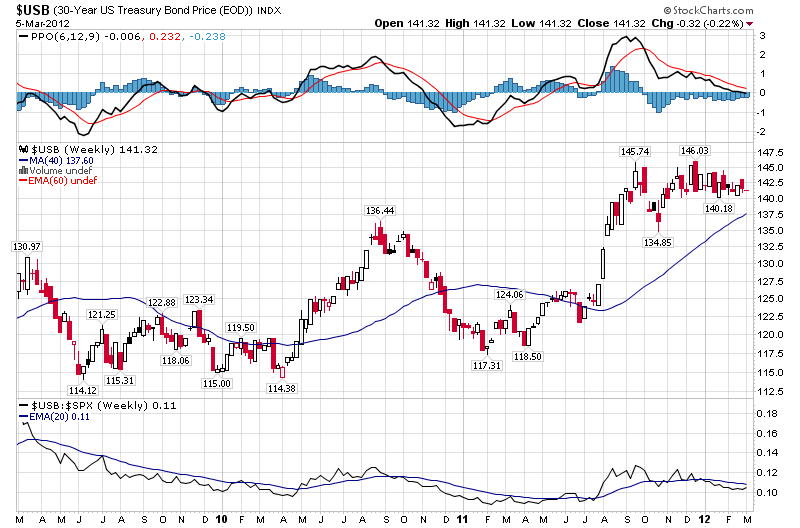
The script that historically gets played out is that after the recession recedes and the economy finishes swooning, a number of good companies find themselves at below fair value, which prompts an increase in the number of mergers/acquisitions, which in turn opens up lending, and the market slowly makes a recovery.
This is a natural process which has been going on for decades, but this time a lot of people are worried that when millions of baby boomers start deleveraging all at once, we won't make it out this time.
What exactly does this mean? In 2008 a lot of major investors were staring into the abyss of what they believed was total world economic collapse to the extreme, where banks would go bankrupt, asset values would collapse, and paper money would be worthless.
It is difficult for us young investors to imagine such a situation, but nonetheless it was a very real possibility in the minds of a lot of people. The central banks (responsible for money supply and interest rate policies) took notice. As a result we have been seeing near-zero-percent interest rates with the hope that it will spur lending and kick-starting the economy into the next cycle. 
Zero-percent interest is not quite the traditional way of dealing with recessions - in fact, it almost smacks of desperation. But, as they say, desperate times call for desperate measures, and since the important people feel like we wouldn't be able to recover from a recession this time, we're stuck with this policy for what Ben Bernanke announced would be 'at least the next 3 years'.
With this, the central banks are clearly trying to soften or avoid altogether the deleveraging cycle, doubling-down on debt with the hope that this will hold us over until the next boom cycle - whenever that might be.
So what do such low interest rates mean for us average investors?
For one thing, there is not a lot of incentive for all you savers out there to keep your money tied up in a bank account. With such low interest rates, a lot of investors are going to seek out ways of getting a higher return for their money, and this usually means investing in the stock market. The baby boomers are taking notice right now and possibly even slowing their mass exodus from their winning assets... or at least this is what the central banks would love for them to do.
The other historical effect of low interest rates as been its impact on commodity prices. The more money there is sloshing around, the more things such as food, gas, and building materials will cost. Traditional hedges against inflation include Gold and other precious metals, the theory being that the more money there is in the financial system (real or leveraged), the more dollars it takes to purchase them. (low interest rates also have an upward effect on commodities). Other alternatives include certain securities such as Real Estate Investment Trusts, or government bonds linked to the Consumer Price Index.
Assuming that the central banks of the world will keep doing everything in their power to keep the monetary dream alive, let's take ride this trend and put some of these inflation hedges in our virtual portfolio.
Lucky for us, Gold had a big fire sale this week, now trading at a 2 month low! I'm all for buying on dips, but to protect ourselves from the gold price going lower I'll scale-into the position, purchasing 50 shares of the Claymore Gold Bullion ETF now, and 50 shares next week. Note that with today's dumping of stocks on the market our VIX shares went up! I won't get complacent however, since these are not meant to make us money and are part of our portfolio to hedge against disaster.