
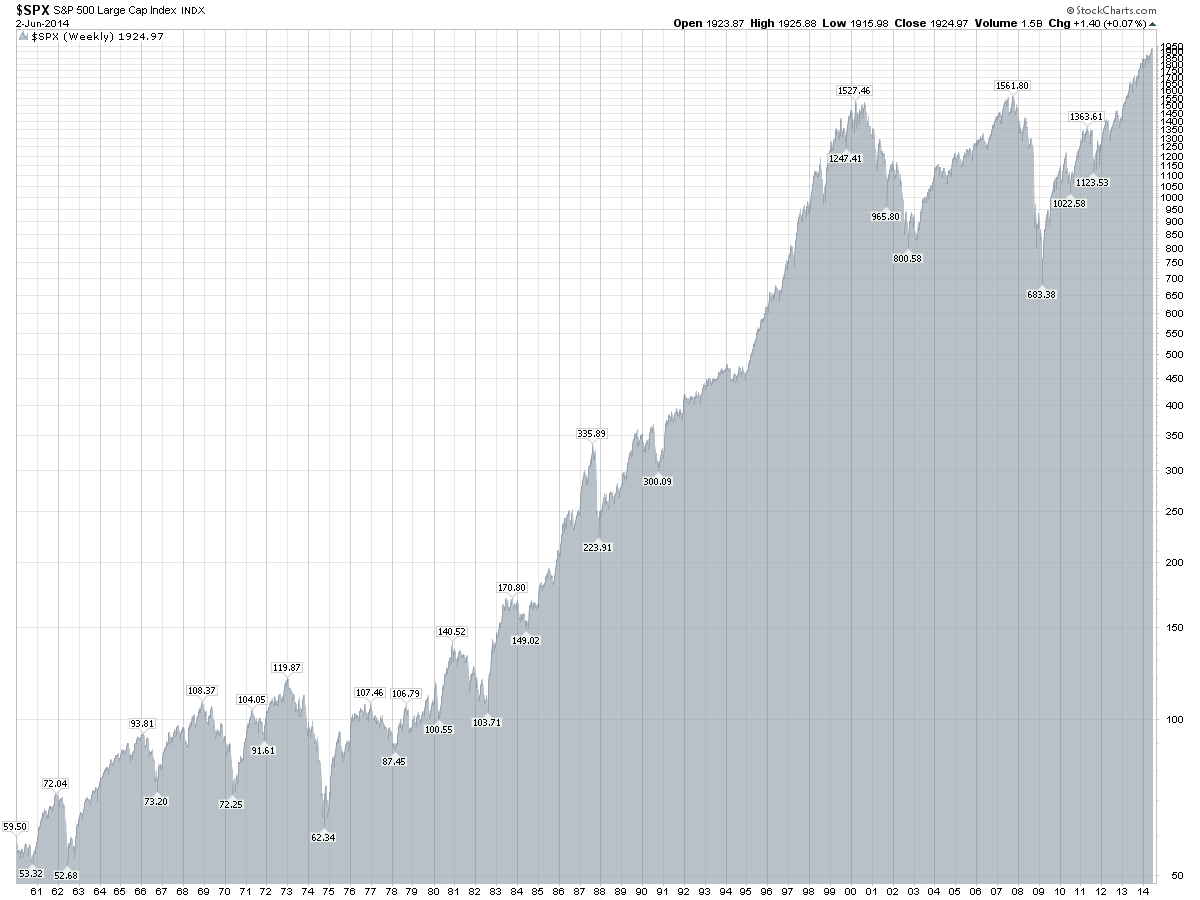
This is a 50-year chart showing the S&P 500 index from the year 1960 to present day (click on the chart for a larger image).
After chopping around in the 60s, the market bottomed round 1975. After that it didn't look back as the market soared to the first of three peaks you see at the top starting in the year 2000.
In 1975, the first wave of baby boomers (born in 1946) were reaching their 30s, and were starting to do things like saving for retirement and buying homes and cars. This demographic had a good hand in the market's dramatic rise during this period, and even if you didn't know anything about investing you might have done quite well just by throwing darts at a newspaper. At the very least, taking part in your company's employee share ownership plan could have meant an early retirement.
In the year 2000, that first wave of boomers turned 55 and were starting to get their financial affairs in order. This meant downsizing their empty-nest homes, and selling off some of their winning stocks to convert them into income instruments such as annuities or bonds. As you can see, the market's rise pretty much stopped during this time and has see-sawed for the past 10 years as companies struggle for growth. There are of course other factors at play here, and the boomers might have been merely a catalyst, but looking at the big picture tells us that a 'buy and hold' strategy might not cut it these days... at least not for awhile.
From 2000 onward there has been a lot of uncertainty in the markets, from geopolitical risk to general economic woes. Add to that some high-frequency algorithmic trading by hedge funds to squeeze out every penny from the markets, and you have Volatility.
In market terms, volatility essentially means that the future price of stocks is anybody's guess, usually because the price has fluctuated greatly in the past. Anyone who owned stock since 2007 knows this all too well. Market statisticians have a number of ways to measure volatility, and the more sophisticated market players will try to capitalize on it.
If the markets are too volatile, you really only have 3 options as an average investor:
1. Do not play: Sell everything, sit in cash, and wait out the storm. The problem with this approach is that no bank cares enough about your liquid cash to pay you a decent interest rate these days, so while you're waiting your money isn't earning much. It's the bet with the least amount of risk, but also little (if any) reward.
2. Buy safe haven assets: Safe haven assets are something everybody wants to be in when the world churns, such as US Dollars, Gold, and Bonds. Unfortunately these days the market can't seem to unanimously decide which assets are safe! As a result, traditional safe haven assets have experienced their own volatile cycles in the past 12 months. For an example of this just look at the USD/CAD currency pair.
3. Hedge volatility: When markets are volatile, we don't want to see any sudden swings in our portfolio. We're in it for the long term, so a nice steady rise over time will help us sleep at night. An important part of a growth portfolio is stocks that have low beta, with Beta being the measurement of how much they follow the market up or down. Low Beta stocks don't rise as much as the markets do on up trends, but they don't fall as much either.
BMO has a low volatility Canadian equity ETF, titled appropriately the "BMO Low Volatility Canadian Equity ETF" (ticker ZLB on the TSE) Its holdings include well known 'stable' Canadian companies such as Loblaws, Tim Hortons, and Shoppers Drug Mart. While these companies aren't exciting, many of them do pay a dividend which the ETF passes on to the holder each quarter (9.5 cents as of last December).
Another way to hedge volatility is to 'buy the VIX'. The VIX is a short name for the Volatility Index - an index that a group of geniuses developed to measure market volatility. How is it done? Simply put, the price of a basket of securities derivatives (in this case, stock options) is calculated and posted as part of the index, the individual prices of which are positively correlated to volatile markets - The higher the value of the index, the greater the historical volatility and/or the greater the expectation of future volatility. Derivatives are typically Options on stock, but can also take other forms. Think of Stock Options as a type of 'insurance' to guarantee loss on a stock purchase - the price for insuring your stock will be higher if your stock has a history of tanking.
The Chicago Board Options Exchange (CBOE) developed the VIX as a way to track the general prices of options, but it has since been used to launch derivatives tied to this index (yes.. they have derivatives on derivatives). Some Exchange Traded Funds also use this index to make this market accessible to the average investor.
A 3-year chart of the Volatility Index confirms what we have seen on the nightly news: The only thing certain is uncertainty! Notice how with each market drop, the VIX shoots up in price. This is due to the strong correlation between dramatic price swings and VIX (options) pricing.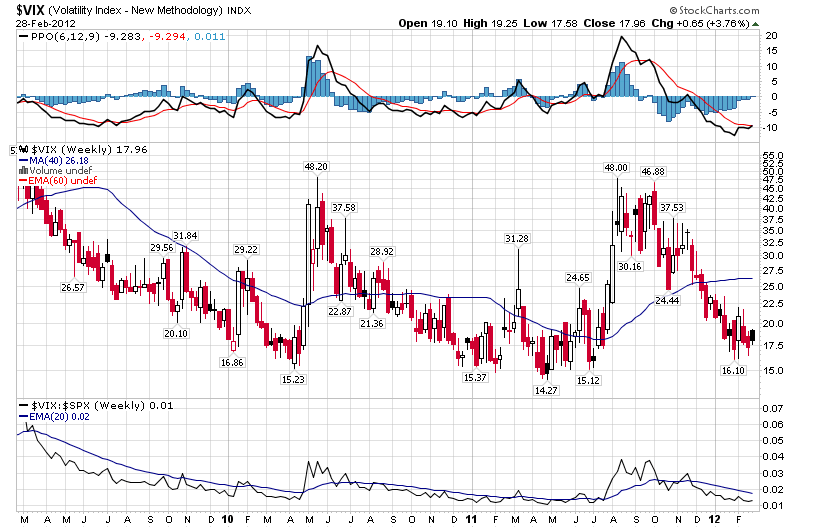
If you do decide to plunge into the market in today's panic-attack driven environment, you should consider adding some VIX shares to hedge your portfolio against any major price swings. If done right, then these swings should only show up as blips in your monthly statement - that is, if markets continue to rise then your VIX shares may go down in value but your core stock picks will be rising. Conversely if markets crash then your core holdings may drop but this will be offset by your VIX shares rising.
As you can see from the next chart, the VIX is at its lowest levels since the August panic. This is because the market has had a nice orderly rise since October to current levels. If history is any indicator, this would be a good place to purchase the VIX, as things might be calm now but we expect, and want to be hedge against, any disaster in the future.
One Canadian ETF which tracks the VIX is 'Horizons Betapro SP500 Short Term VIX Futures' and has the symbol HUV.
I'll add 100 shares of the ZLB ETF to the portfolio, and then once we're ready to start adding equities we'll hedge our purchases by adding HUV.